
The current weekend tournament model makes it difficult for baseball players to truly maximize their time for development and exposure — it's not their fault. Our game structure looks nothing like a regular baseball game — and that's by design.
Hitters and pitchers get up to 4x more reps, 4x faster compared to a regular season of baseball games.
Every player gets MLB-level stats on their profile and professional-quality video for reviewing/social media — together, they paint the full picture of a player and drive real development, recruitment, and exposure — all in a fraction of the time.
Games run once a week and last no more than two hours — structured so hitters and pitchers get high-quality work without burning out.
Every pitcher faces at least 12 batters. Every hitter gets 12 at-bats in a single game — about as many as (or more than) a full weekend tournament, packed into two hours.
Pitchers throw roughly 40–60 pitches with built-in rest and only one game a week, so no one overthrows to chase a win.
Four hitters and four pitchers play in a single game. Two pitchers work at a time, rotating through the same four hitters for three to four sets — like innings of work.
Defense, your way. Outdoor games offer optional fielding — a player who plays a position can come get a full game of defensive reps. Indoor games keep the same hitting-and-pitching format, without the field.
The Alonzo League only structures the games. The rest of the week is yours. Instead of generic team practices, players can spend that freed-up time working on their own or with a personal development coach of their own choosing.
No pressure, no forced picks. This is exactly how players develop faster: focused, individual work stacked on top of high-quality game reps.
Batting average doesn't tell the whole story. Pitching ERA doesn't tell the whole story. We track the quality metrics that college and pro evaluators really care about — for hitters and pitchers alike. And the same numbers do double duty — they show each player exactly where to focus to improve.
Recruiters want pitchers that induce weak contact consistently, limit hard contact consistently, pitchers that generate a lot of swings and misses, pitchers that get hitters to chase out of the zone, pitchers that limit walks, and pitchers that strike hitters out. This is exactly what the Alonzo League tracks.
Recruiters want hitters that hit the ball hard consistently, hit the ball in the outfield gap consistently, hitters that swing and miss minimally, hitters that chase pitches out of the zone minimally, hitters that take their fair share of walks, and hitters that strike out minimally. This is exactly what the Alonzo League tracks.
These are the same metrics MLB has used to evaluate players for nearly a decade, and college programs are adopting them now. Here is an example of two MLB players' profiles.
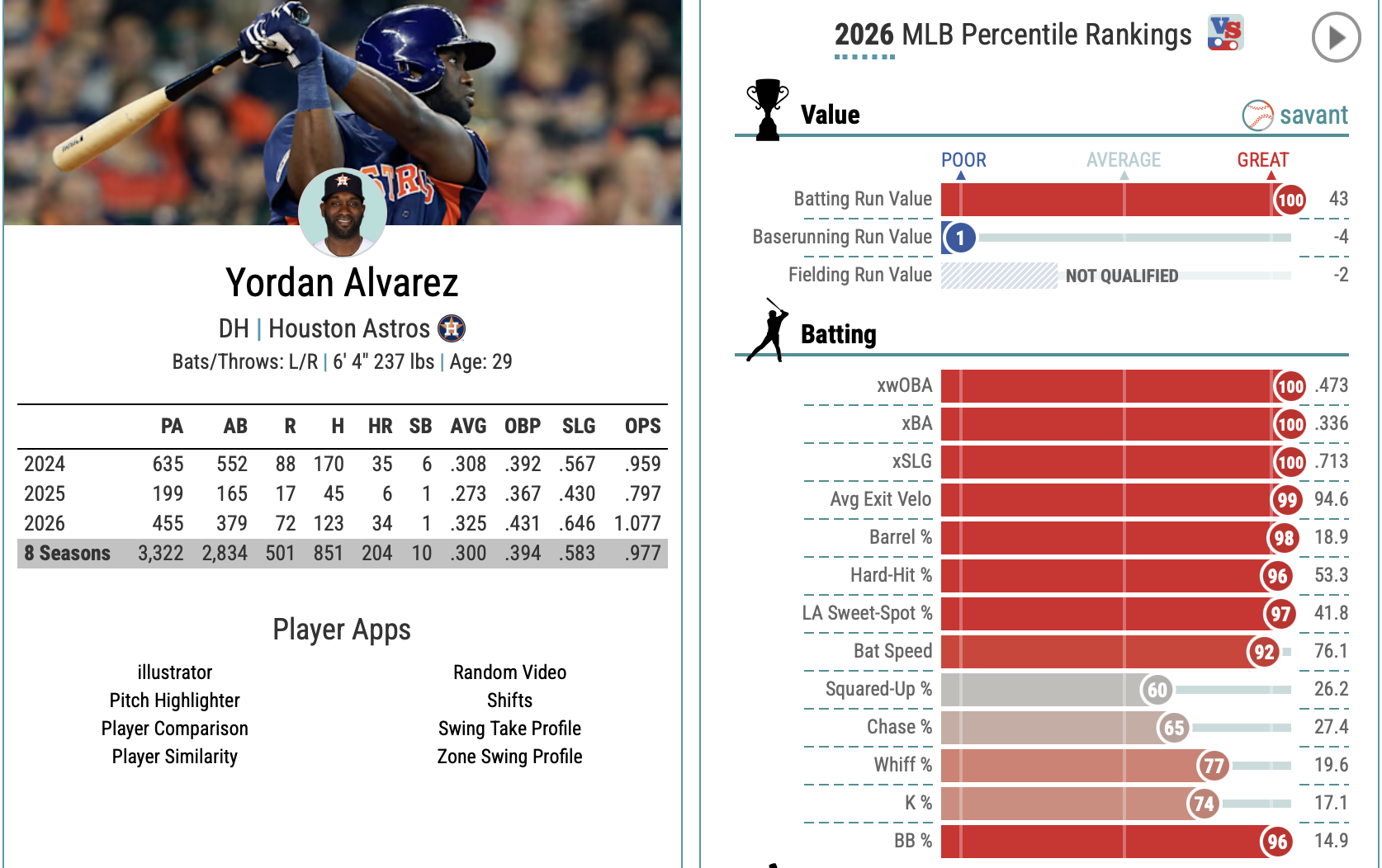
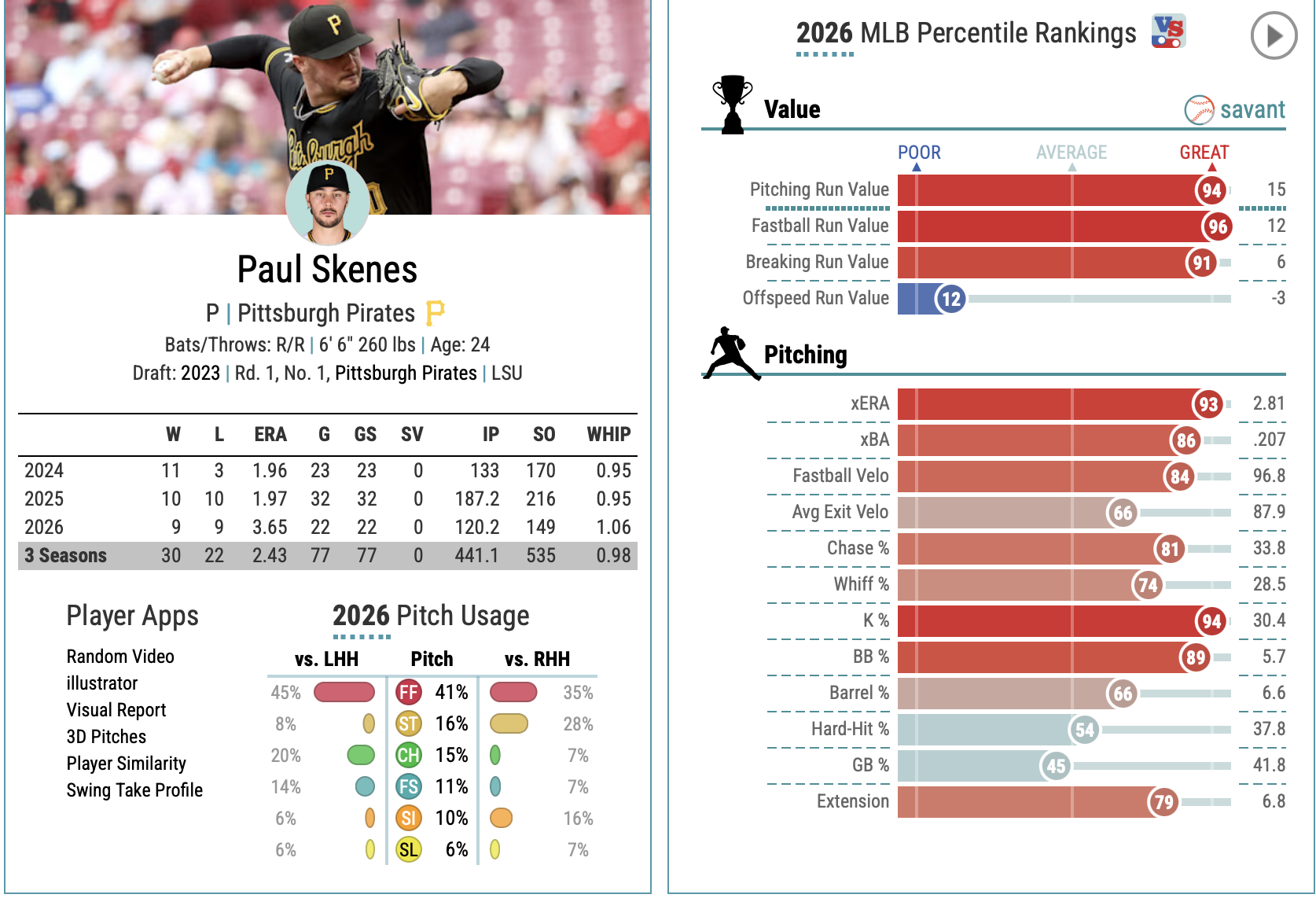
And here's the same style of report from our own stat tracking model — an actual Alonzo League hitter and pitcher at the high school varsity level:
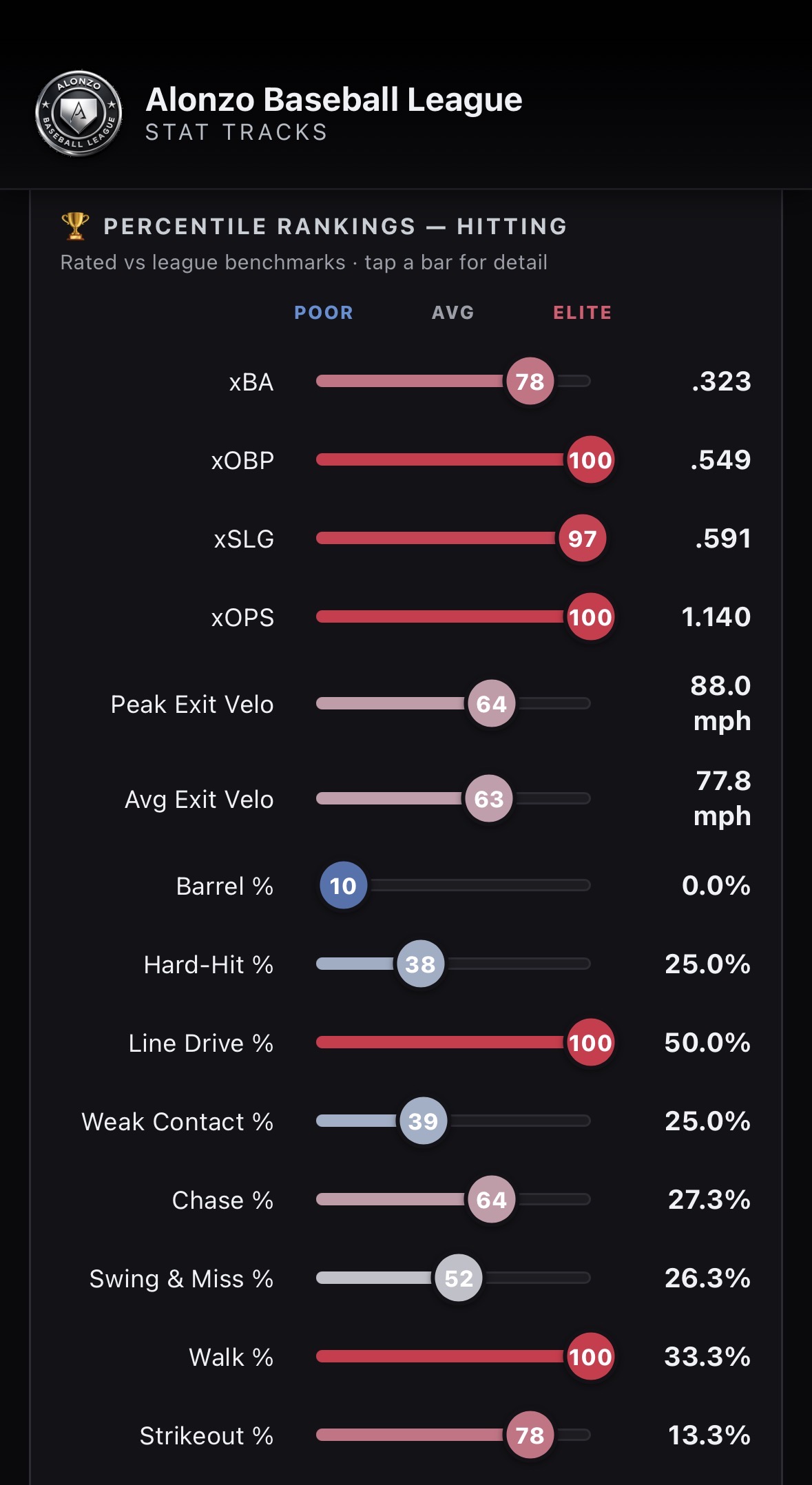
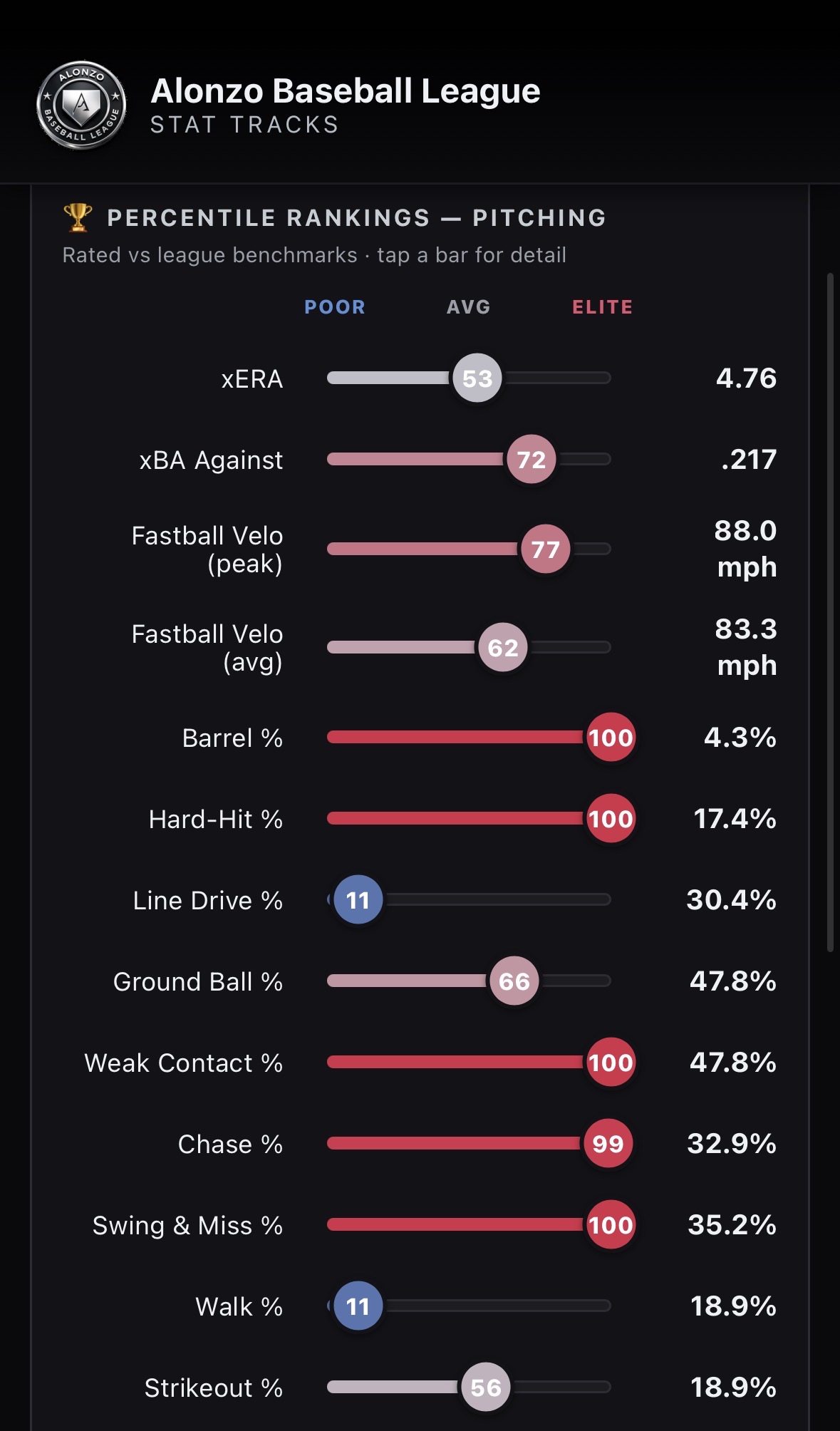
Our stat tracking model also adjusts for competition level, including JV (junior varsity) players and below.
And it's not just numbers. Every at-bat in the League is filmed, so players walk away with game film to pair with their stats and post for recruiters — where social media has become one of the biggest avenues in recruiting today.
Example posts — a hitter and a pitcher:
Scenario: Two hitters each get 10 at-bats in a typical weekend tournament. The first hitter squares the ball up hard four times but has bad luck: no base hits to show for it, yet a 40% hard hit rate — and an expected batting average of around .350 — if this hitter was in the Alonzo League. The second hitter gets four base hits, but only two were hit hard. This would mean this hitter would have only a 20% hard hit rate, and an expected batting average of around .215, if he was in the Alonzo League.
On a regular baseball stat sheet, the second hitter looks better, but if a college coach had the game stats that the Alonzo League provides, it would be easier for the coach to see that it was the first hitter that was actually the better hitter.
It would also show the second hitter where he needs to improve, instead of attaining a false sense of accomplishment from the box score.
That's what our stats reveal that a regular baseball game box score hides.
The Alonzo League is flipping the weekend tournament model: every player develops faster than they would grinding a traditional travel schedule, because our structure is designed around quality reps and individual growth outside of our games.
It also gives families their time back. Today's travel baseball is a massive time commitment. The Alonzo League trims that down to what actually moves the needle, so players and parents can spend their time preparing (or relaxing) instead of just performing.
"Amateurs spend more of their time performing than they do preparing. Meanwhile, professionals spend more of their time preparing than they do performing. That's the difference between the two." — Myron Golden
per player for the entire season.
Each hitter gets between 120 and 180 at-bats. Each pitcher gets to face between 120 and 180 batters. Each batter and pitcher receives advanced-level stats plus professional video for each outing.
Reach out to learn how to join the Alonzo Baseball League.
Get in TouchNot in the same game — that's what keeps the 12-at-bat, under-two-hour format intact. A two-way player simply enrolls twice, once as a hitter and once as a pitcher, and does one role per game.
Players who enroll in the Alonzo League are required to already have a team of their own — this is sandlot-styled baseball. Players create their own team and there are no coaches during the games. A team is made up of four hitters and four pitchers, so choose your teammates wisely to keep the games competitive.
The price to join the league is $3,000 per player for the full season. The season consists of between 10 and 15 games.
Every season is scheduled for 10 to 15 games, and we always aim for the full 15. The only thing that would keep us short is weather combined with the indoor facility being unavailable for makeup games — but no matter what, a minimum of 10 games is guaranteed.
The Fall/Winter 2026 season is scheduled to start on September 19th and end on January 9th — a 15-game schedule. Games won't be played on Thanksgiving weekend, Christmas weekend, or New Year's weekend.
Outdoor games are held at the Correa Elite Academy Fields in Humble (4401 Theiss Rd, Humble, TX 77338). Indoor games are held at SP Cages (5700 Star Lane, Houston, TX 77057). We prioritize outdoor games first and only move indoors if the weather requires it.
Both. Players stay close to their age group but can play up when they're ready — a capable 13-year-old with the 14U group, or a strong freshman at the varsity level — within safe limits.
The metrics we track are exactly what college and pro evaluators look for, and every at-bat is filmed. Players leave with MLB-level stats plus professional video to send to recruiters and post on social media.
See an example post:
There are no team awards. However, there will be individual awards for the most valuable hitter and the most valuable pitcher. Each of these players will receive a prize at the end of the season.
Four hitters and four pitchers. Two pitchers alternate through the same four hitters, three to four sets each — 12 at-bats per hitter, under 60 pitches per pitcher, all in under two hours.
Here's a short video: